We Were Told Again and Again That We Were World Changers
The violent assault that turned a man into a maths genius
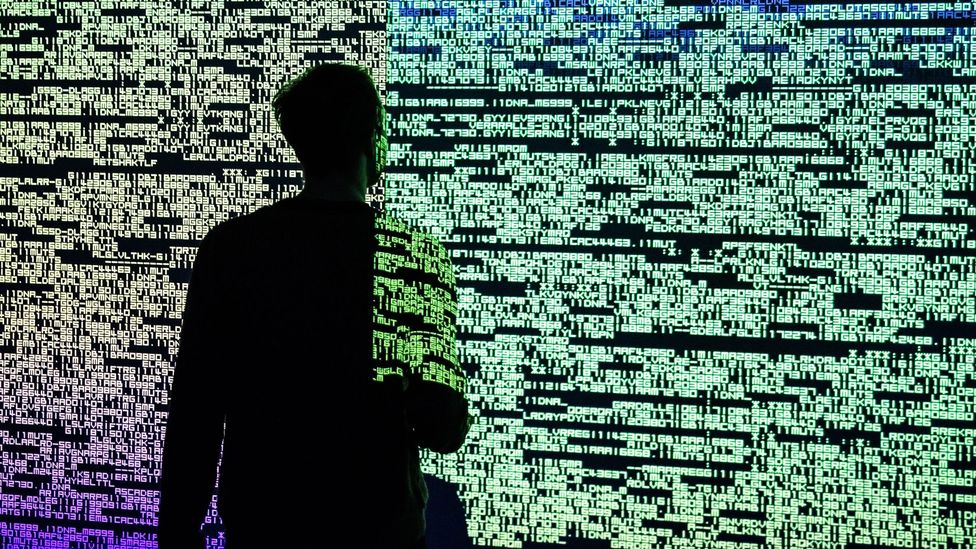
Futon salesman Jason Padgett cared little about anything beyond partying and chasing girls, then one fateful night changed him forever.

BBC Future has brought you in-depth and rigorous stories to help you navigate the current pandemic, but we know that'due south non all yous desire to read. So now we're dedicating a series to help you escape. We'll be revisiting our most popular features from the final 3 years in our Lockdown Longreads .
You'll discover everything from the story about the world'due south greatest space mission to the truth well-nigh whether our cats really love us, the epic chase to bring illegal fishermen to justice and the pocket-size team which brings long-buried World War Ii tanks back to life. What y'all won't find is any reference to, well, yous-know-what. Savour.
Jason Padgett sees maths everywhere. Fifty-fifty something as ordinary equally brushing his teeth is governed by mathematics – he turns the tap on and dips his toothbrush into the water sixteen times.
"I don't know why I like perfect squares," he says. "It's not just a perfect square, information technology's 2 to the ability of four or four squared only I just like perfect squares… I automatically do that stuff with everything."
Padgett is so obsessed with maths and understands such complex concepts, he's been called a genius. He certainly has a rare talent for drawing repeating geometric patterns – known as fractals – by paw.
You might also like:
• Is information technology right to utilize Nazi science?
• The maths problem that could bring the globe to a halt
• What information technology's similar during a chemical attack
Merely the former futon salesman from Alaska hasn't ever had a way with numbers. Just under 17 years ago he was living a very different life in Tacoma, Washington.
"I was very shallow," he laughs. "Life rotated around girls, partying, drinking, waking upward with a hangover and and then going out and chasing girls and going out to bars again."
Maths wasn't on his radar whatsoever.
"I used to say 'math is stupid, how can you use that in the real world'? And I thought that was like a smart statement. I really believed it."
But on the night of Friday 13 September 2002 everything changed. (Read more than about why some people become sudden geniuses).
While out with friends, Padgett was attacked and robbed past ii men exterior a karaoke bar. They took his already torn leather jacket.
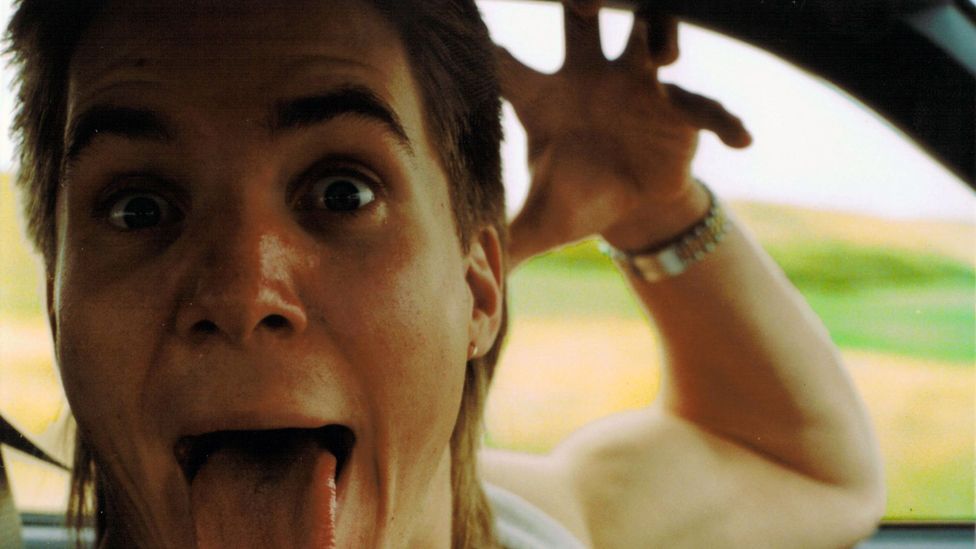
Padgett cared niggling about maths, instead focusing on having fun earlier the attack that inverse the mode his brain worked (Credit: Jason Padgett)
"I heard as much equally felt this deep, low-pitched thud equally the showtime guy ran up behind me and smashed me in the back of the caput," he recalls. "And I saw this puff of white calorie-free but similar someone took a picture. The adjacent thing I knew I was on my knees and everything was spinning and I didn't know where I was or how I got at that place."
Padgett staggered to a hospital across the street where he was told he had concussion and a bleeding kidney thank you to a dial to the gut. "They gave me a shot of pain medication and sent me home," he remembers.
But in one case abode, Padgett's behaviour changed speedily and dramatically. He had sustained a traumatic encephalon injury, which can bring on obsessive compulsive disorder - OCD. In Jason's case, he became increasingly afraid of the outside globe and would only get out his house to stock upwards on food.
"I just call back nailing blankets and towels over all the windows in the house… I remember actually using this spray foam and gluing the front door shut."
The OCD had made Padgett irrationally afraid of germs, which had a knock-on upshot on his daughter who would come up to stay with him amidst custody negotiations with his ex-partner.
"When she would come up over I would obsessively wash my easily and clean," he says. "The very first thing I would want to do is go her shoes off, get her into clean clothes, launder her hands."
But while Padgett was experiencing all these negative consequences from his attack, something incredible was happening too. The manner Jason was seeing things changed.

Following the trigger-happy assault, Padgett withdrew from the outside world and developed obsessive behaviours (Credit: Getty)
"Everything that was curved looked like it was slightly pixelated," he explains. "Water coming down the drain didn't look like it was a smooth, flowing thing anymore, it looked like these footling tangent lines."
The same thing happened with clouds, sunlight streaming between trees and puddles. To Padgett, the world substantially looked similar a retro video game. Seeing such a radically different view of his surroundings evoked conflicting emotions in Padgett. "I was surprised…confused. It was beautiful simply it was also scary at the aforementioned time."
Because of these visions, Padgett began to call up about huge questions in relation to mathematics and physics. Given his hermit-like beingness at that time, the internet became a valuable source of data to him as he read extensively about mathematics online.
He stumbled beyond a webpage about fractals which struck a chord with him. Information technology'southward a hard mathematical concept which, put at its nearly basic, can be likened to a snowflake. When yous zoom in, you will see it's fabricated upward of smaller snowflakes connected together, zoom in once again and those snowflakes are fabricated of smaller snowflakes, and and so on until infinity.
Padgett was fascinated by this concept only didn't notwithstanding accept the words to depict information technology until one day his daughter asked him how the TV worked.
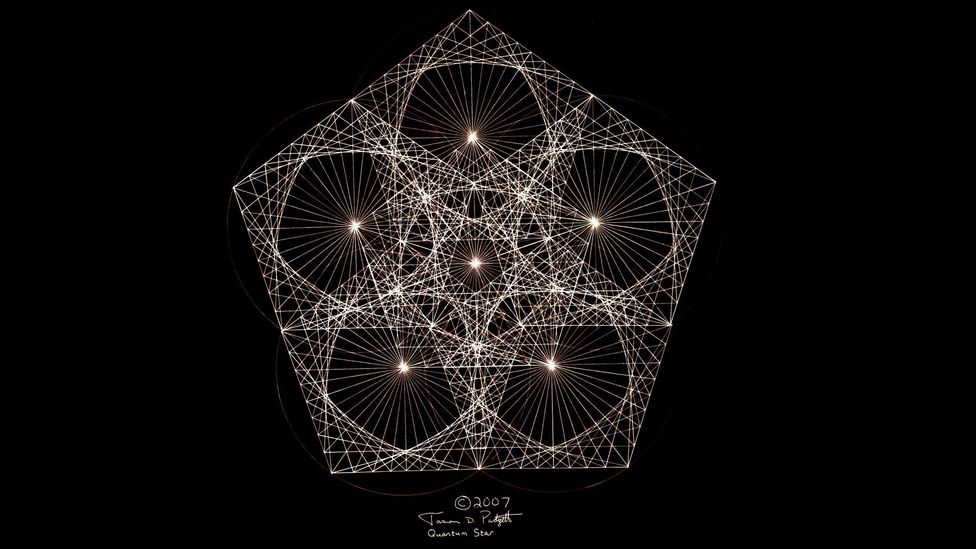
Since the assault Padgett has been able to draw repeating geometric patterns known as fractals by hand (Credit: Jason Padgett)
"When you're looking at a TV screen and you encounter a circle information technology's really not a circle," he says. "Information technology'due south made with rectangles or squares and, if you look close, the edge of the circumvolve is really a zig zag. You can take those pixels and cut them in half and cut them in half and you get closer and closer to a perfect circle but you lot never actually attain one because y'all can continue cut the pixels in half forever, then the resolution gets better merely y'all never have a perfect circle."
Padgett felt compelled to explore this intriguing concept further. So, he began to depict. And he kept cartoon.
"I had literally a thousand or more drawings of circles, fractals, every shape that I could manage to draw. It was the only way I could manage to communicate effectively what I was seeing."
Padgett believed his drawings "held the central to the universe" and were so important that he needed to take them everywhere with him.
While on a rare trip out one twenty-four hour period, he was approached by a man who had noticed Padgett with his drawings and told him they looked mathematical.

Jason Padgett had been a daybed salesman before the violent attack that changed his life (Credit: Jason Padgett)
"I'grand trying to describe the discrete structure of space fourth dimension based on Planck length (a tiny unit of measurement developed by physicist Max Planck) and quantum black holes," Padgett told him. It turned out the man was a physicist and recognised the loftier-level mathematics Padgett was cartoon. He urged him to have a maths course, which led Padgett to enrol in a community higher, where he began to learn the language he needed to draw his obsession.
After iii and a half years of living like a virtual hermit, going to school changed everything for Padgett. He started to get psychological help for his OCD and fifty-fifty met the woman who would go his wife.
But why was he seeing things in such a strange and different way? Why was his world now comprised of geometric shapes and graphs?
Poetically, it was television that again provided him with a clue. Padgett saw a human being, a so-called savant, who had boggling numerical abilities and talked about what numbers looked like to him.
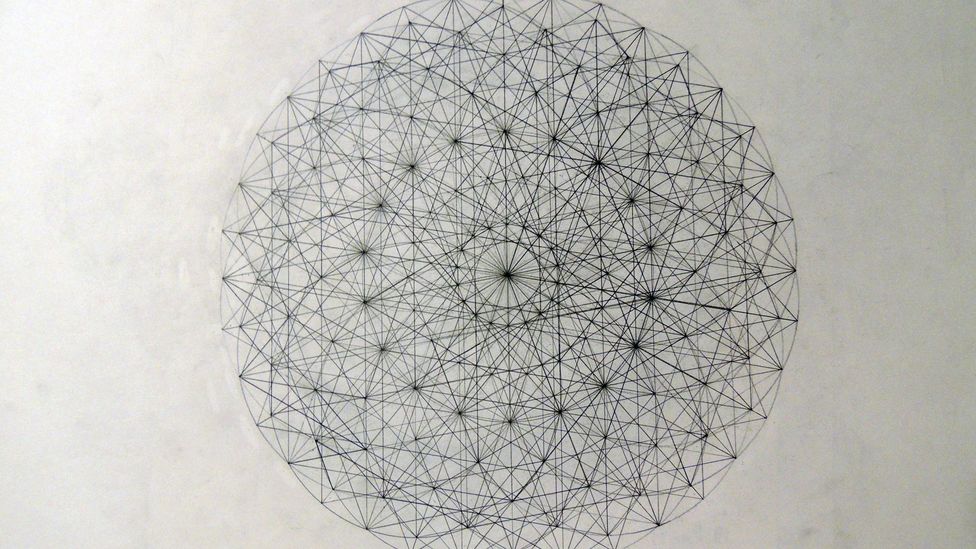
A physicist who recognised the drawings that Padgett was producing set up him on a new path past urging him to study mathematics (Credit: Jason Padgett)
"I would always describe that math was shapes non numbers and that was the first fourth dimension I'd heard anybody simply me talk about what numbers looked similar," says Padgett.
He scoured the cyberspace for more information and came across Berit Brogaard, a cognitive neuroscientist now at the University of Miami. The pair spent hours talking on the phone and from these conversations, Brogaard hypothesised that Padgett had synaesthesia – essentially a cross-wiring of the encephalon in which the senses go mixed up. (Find out more well-nigh synaesthesia — and whether it can be learnt).
It is estimated to effect but around 4% of the population. Some synesthetes might see sure colours when they hear music or smell something that's not there when feeling a particular emotion.
The condition is caused by connections between parts of the brain that are non there in other people. You tin be built-in this fashion or some type of trauma, an injury, a stroke, an allergic reaction, tin change the brain.
Brogaard believes the brain injury Padgett sustained caused him to develop a class of synaesthesia where certain things triggered visions of mathematical formulas or geometric shapes, either in his mind or projected in front of him. She also hypothesised that synaesthesia fabricated Padgett an acquired savant.
"Most of us don't have that kind of insight because we don't visualise mathematical formulas," says Brogaard.
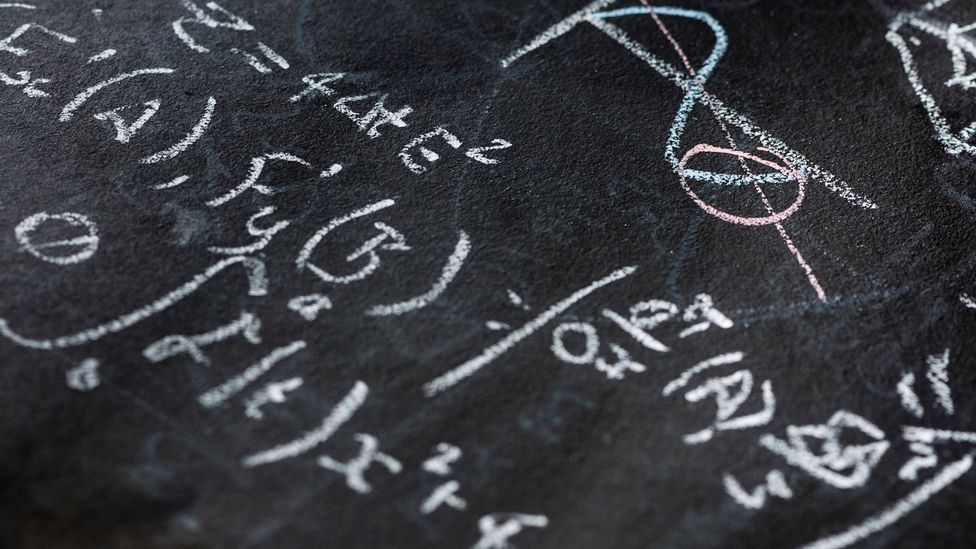
Padgett developed a form of synaesthesia that gave him visions of mathematical formulas (Credit: Alamy)
To test these ideas, Brogaard brought Padgett to the Brain Research Unit of Aalto University in Helsinki, where he underwent a series of brain scans.
While in the MRI scanner, hundreds of equations, including fake ones, flashed on a screen in front of Padgett's eyes. The researchers then watched which parts of his brain lit upward in response.
"They establish that I had admission to parts of the brain that we don't accept witting admission to and also the visual cortex was working in conjunction with the part of the brain that does mathematics, which plain makes sense," says Padgett.
Brogaard'due south hypotheses turned out to be true. Padgett was formally diagnosed with acquired savant syndrome and a form of synaesthesia. Finally, he had answers.
Since his diagnosis, Padgett has published a book about his experience called Struck by Genius, he's toured the world telling people his story and educating them well-nigh maths. He is aiming to help others who have had unique or rare/interesting lives by getting their stories published or made into movies. He even sells his drawings of fractals.
The two men who attacked him that fateful September night were never convicted despite Padgett identifying them and pressing charges.
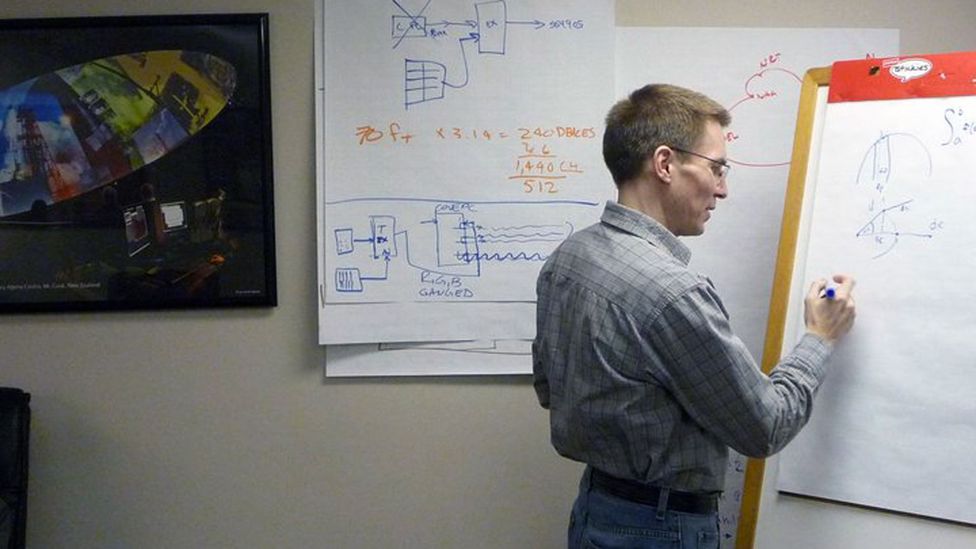
His unique style of seeing the earth has allowed Padgett to grapple with some of the about circuitous mathematical problems (Credit: Jason Padgett)
Years later, all the same, one of the men, Brady Simmons, wrote to Padgett to apologise while he was undergoing handling for prescription drug addiction following a suicide attempt. In a sense, two lives were inverse in the years that followed the attack.
"I'm a completely unlike person," says Simmons. "When I look dorsum the abysmal person that I was in the by, I just don't see how I existed on that level."
Padgett too feels like he is a different person than he was before.
"I see it [beauty] everywhere," he says. He is mesmerised by simple things that most people don't even notice such as raindrops falling on a puddle.
Through Padgett's eyes, the puddle is transformed into circuitous rippling patterns, overlapping and forming shapes like stars or snowflakes. And he wants everyone else to see what he sees.
"You should exist walking around in accented anaesthesia at all times that reality fifty-fifty exists," he says. "I'm having this mathematical awakening and all around us is absolute magic or about every bit close as y'all can get to magic."
--
Join one million Future fans by liking usa on Facebook , or follow united states of america on Twitter or Instagram .
If y'all liked this story, sign up for the weekly bbc.com features newsletter , called "The Essential List". A handpicked selection of stories from BBC Futurity, Culture, Worklife, and Travel, delivered to your inbox every Friday.
vasquezwhoust1944.blogspot.com
Source: https://www.bbc.com/future/article/20190411-the-violent-attack-that-turned-a-man-into-a-maths-genius
0 Response to "We Were Told Again and Again That We Were World Changers"
Post a Comment