Why Fies My Glucometer Give Me Vonglicting Reading
Since your readings decide your insulin doses, nutrition choices, and other health factors, having an accurate claret glucose meter is crucial for managing your diabetes.
Read on to swoop into:
- How Blood Glucose Accuracy is Determined
- 8 Factors That Bear on Meter Accuracy
- How to Choose an Authentic Meter
- How to Exam Your Meter
How Blood Glucose Accurateness is Determined
Blood glucose is measured primarily in two means:
- Laboratory tests performed by professional healthcare providers
- Personal blood glucose meters
How are these tests different?
Personal meters mensurate your blood glucose using a sample from your fingertip (or alternate site), so analyze the whole blood, including scarlet blood cells and all.
In a lab test performed by clinical staff, the sample is typically drawn from a vein in your arm and processed to remove red blood cells, so simply the plasma is tested.
Virtually all home glucose meters factor in the divergence of using a whole blood sample while providing a test effect that is considered plasma equivalent.
Which is more accurate?
Lab tests mostly demonstrate a higher level of accuracy than personal blood glucose meters, merely fifty-fifty these machines can have a slight margin of error. Claret glucose meter test results are not exact measures, only they're designed to give you accurate readings for daily treatment decisions when you're not at a doctor's office.
Without going into particular on how your circulatory organisation works, there are other factors that may cause the two readings to vary slightly, merely typically a upshot from a meter that's inside 15-20% of your lab reading is considered accurate. Then, if your lab result says that your blood glucose is 100 mg/dL, your meter might study your results as 85 mg/dL or 115 mg/dL and still be considered accurate.
Who determines accurateness?
ISO, as well known as the International Organization for Standardization, is responsible for developing and publishing specifications for products and services. The standards gear up by the arrangement are intended to ensure quality, safety, and efficiency, so that you can exist confident in your purchases.
Claret glucose meters are i of the many products with ISO standards. For a system to encounter the latest ISO 15197:2013 accurateness standard, 95% of blood glucose results must be inside fifteen% (for values equal to or greater than 100 mg/dL) and 15 mg/dL (for values below 100 mg/dL). It also requires 99% of results to fall within zones A or B of the Consensus Error Grid.
The FDA, which oversees products cleared in the U.Southward., has its own system accurateness recommendations. Their nigh recent draft guidance represents their current thinking on accurateness and relies heavily on the ISO guidelines.
8 Factors That Can Affect Glucose Meter Accuracy
Test Strips
When you use a exam strip, the glucose in your blood interacts with enzymes on the strip. This releases electrons, creating an electrical electric current. The meter and then converts that into a concentration of glucose to give you a reading.
Considering this procedure is so complicated, your test strips tin exist very sensitive to variables. Inaccurate results can come from test strips that:
- Are damaged or expired
- Are affected by heat or moisture
- Do not have enough blood applied
- Are not designed for your meter
- Have contaminants (oil, balm, food) on the sample area
Accuracy Tip: You should e'er keep your examination strips in their container, stored at the temperature specified past the manufacturer. Test strip designs may vary, so information technology's of import to understand where the blood sample should exist applied to avoid testing errors or inaccurate results. Also brand certain that you're using tests strips that accept not expired and are made specifically for your meter model.
Environmental Conditions
The chemistry of your test strips, as well as your own blood flow and composition, can exist affected by the atmospheric condition of your environs.
An active component in the test strip chemistry, called an enzyme, tin exist sensitive to temperature and humidity weather condition. Temperature and humidity extremes can cause the enzyme activity to decrease and affect the accurateness of results.
Your body also reacts differently at different temperatures. High temperatures can brand information technology easier for yous to go dehydrated and concentrate (elevate) glucose levels, while depression temperatures may affect apportionment and lower blood catamenia to testing sites.
Some studies accept shown devices to over or under gauge glucose when testing at high altitudes. If this is of business organization, confirm the altitude rating for your device.
Accurateness Tip: Keep test strips at room temperature and keep the container closed so your strips are protected from the elements. This ways taking them with y'all wherever you go to avoid leaving them in a hot or cold motorcar. If you have been exposed to colder temperatures and your hands do non feel warm, launder and concur them nether warm h2o earlier taking a exam to improve blood flow and reduce meter errors.
Substances on Your Skin
Annihilation you touch or put on your peel tin can cease upward in your blood sample and then on your test strip. Since many current meters utilize a micro-sized blood sample, just touching something that contains sugar and non washing your hands can affect your readings. If you recently washed your hands merely didn't dry them completely, the h2o left on your fingers tin have a diluting effect on the sample, as well.
Accuracy Tip: E'er wash and thoroughly dry your hands earlier every test.
Amount of Blood in Your Test Strip
Information technology's possible to take as well much or not enough blood in the examination strip sample expanse, which can pb to inaccurate results or an fault reading.
Accuracy Tip: Your meter should state the required blood sample size, similar 0.5 microliters, so you have an understanding of how much blood is needed for testing. Avert squeezing direct around the lanced surface area when forming a claret drop. Y'all can likewise experiment with different size lancets to find i that produces the corporeality you need.
Testing Site Location
Because of the physiological differences in the apportionment of certain areas of your body, examination results from alternating sites (like your forearms, calf, or thigh) are frequently less accurate than testing with your fingertip. This is due to the frequency with which fresh claret is circulated to each part of the trunk. If you have recently eaten, exercised, or taken medication that could lower your glucose, these changes may not be detected as chop-chop in alternate sites as in the fingertip.
Accuracy Tip: Cheque the instructions for your meter to empathise how alternate site testing may affect your results.
Hematocrit Variations
Variations in your hematocrit — the proportion of crimson blood cells in your blood — can affect the accuracy of your blood glucose meter. These variances in the amount of crimson blood cells tin can interfere with the calculation of glucose.
The ISO 15197:2013 standard requires performance criteria that limits the issue of varying hematocrit levels on a claret glucose meter. If the meter you're using does non meet this criteria, you lot may receive inaccurate results.
Accuracy Tip: Many meters with the latest technology can detect and correct for hematocrit variations. Cheque the guide that came with your meter or contact the manufacturer for more details.
Meter Variances
The calibration process, enzymes, and reckoner programs (algorithms) in every meter on the market are different. Each brand's manufacturing, chemistry, and calibration procedure can differ, fifty-fifty across production lines from the same company. If you lot're using ane meter brand/model in the morning and another at night, your readings can have significant variations.
Accuracy Tip: Stick with ane meter to brand it easier to interpret your glucose levels and the effect of handling decisions.
Incorrect Coding
A meter that requires coding means you'll need to input a code printed on each test strip vial in lodge to calibrate it before use. If the lawmaking doesn't match correctly, information technology could lead to inaccurate readings.
Accuracy Tip: Many "No Code" meters are available at present, which lets y'all avoid this step. But if you lot accept a meter that still requires coding, make sure you input the lawmaking correctly to avoid inaccuracies.
How to Cull an Accurate Meter
Independent testing, like the study done past the Diabetes Technology Society, is helpful to compare the functioning of top commercially available glucose meters. This written report tested meters and test strips which were independently purchased from stores across the country, and representative of what a consumer would purchase.
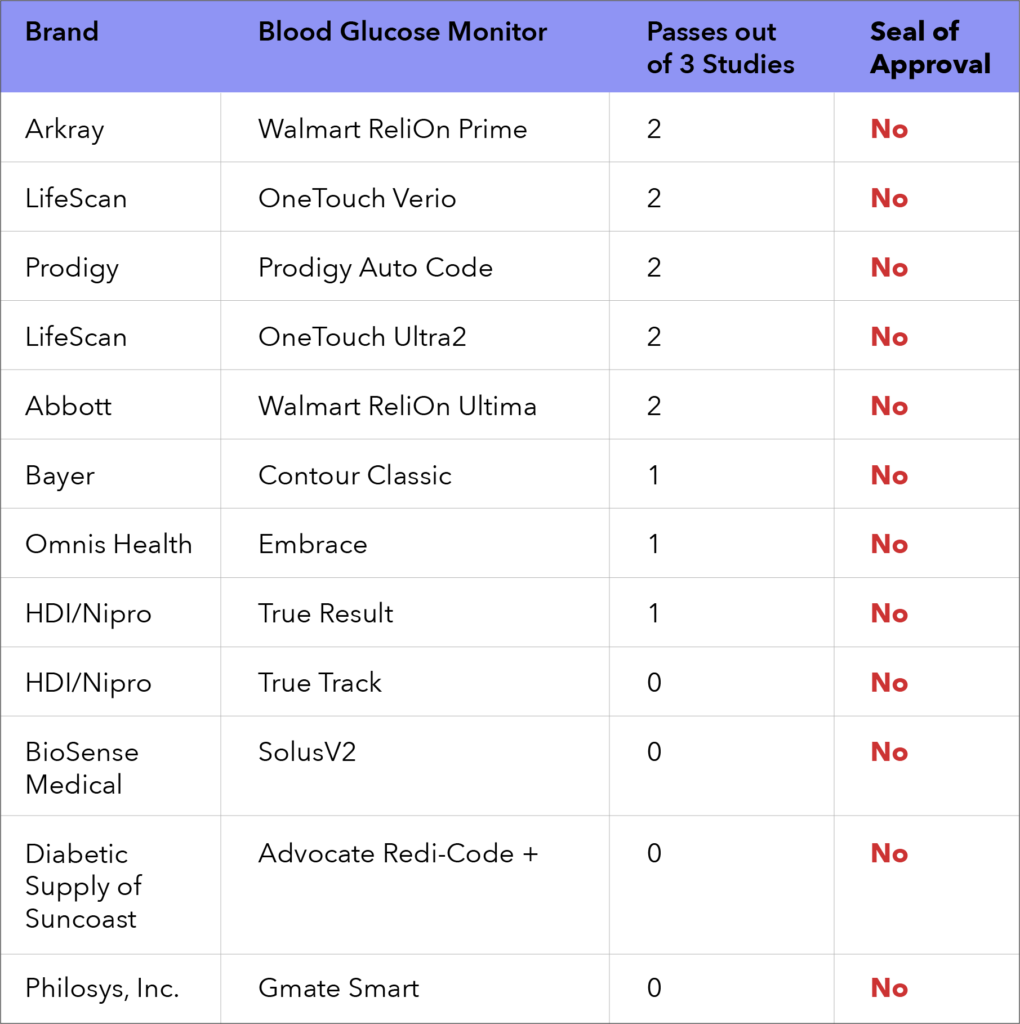
Later on testing the products over 300 times at three dissimilar clinical sites, the results showed that over 66% of the top meters on the market today didn't laissez passer the rigorous written report.
A surprising number of name brand meters did non pass all studies. Check the list below to encounter the 12 meters that failed i or more study.
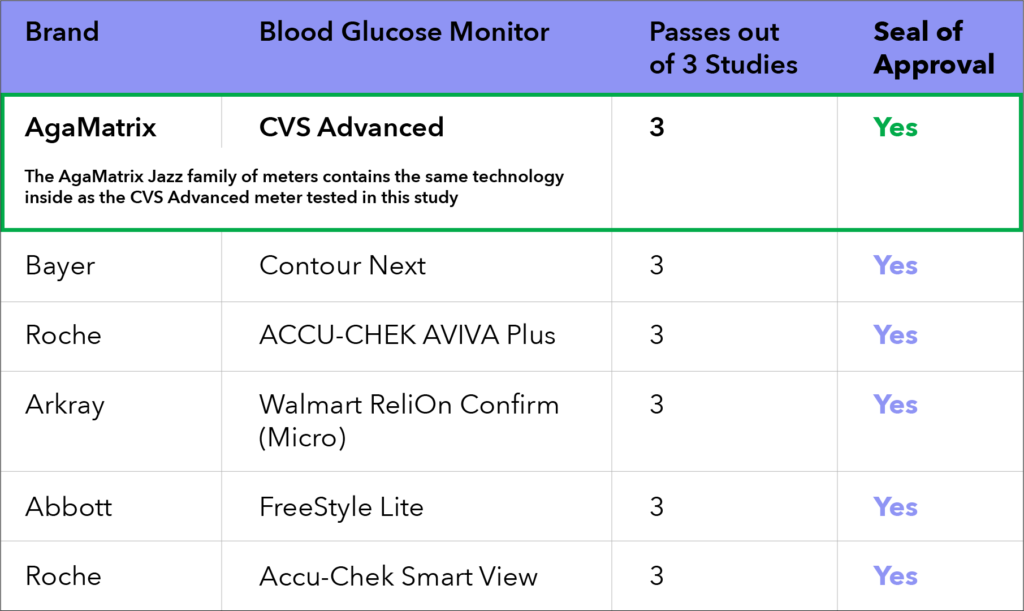
The post-obit devices passed the exam and received the Diabetes Technology Society's Seal of Approval:
AgaMatrix & Meter Accurateness
In the in a higher place-mentioned study, you can see that AgaMatrix performed as proficient or better than many of the leading brands. The results showed that 97% of our readings were within ±xv% or ±15 mg/dl of the lab test results.
All AgaMatrix products, including blood glucose meters and test strips, are backed by world-class manufacturing techniques in our ISO 13485:2016-certified and FDA-registered facility. We alive by the principles of efficiency and precision by continuously reviewing our pattern, assembly, and automation practices so that people living with diabetes can have access to affordable, accurate technology that helps them better manage their wellness.
To find an AgaMatrix meter that suits your lifestyle, you can store hither or contact us for assistance!
vasquezwhoust1944.blogspot.com
Source: https://agamatrix.com/blog/blood-glucose-meter-accuracy/
0 Response to "Why Fies My Glucometer Give Me Vonglicting Reading"
Post a Comment