Hidden Images That Has a Picture in a Spiral Art



Ambiguous images or reversible figures are visual forms which create ambiguity past exploiting graphical similarities and other properties of visual organization estimation betwixt two or more distinct epitome forms. These are famous for inducing the phenomenon of multistable perception. Multistable perception is the occurrence of an image being able to provide multiple, although stable, perceptions.
One of the earliest examples of this type is the rabbit–duck illusion, get-go published in Fliegende Blätter, a German humor magazine.[1] Other classic examples are the Rubin vase,[ii] and the "My Wife and My Mother-in-law" drawing, the latter dating from a German postcard of 1888.
Ambiguous images are important to the field of psychology because they are ofttimes research tools used in experiments.[3] There is varying evidence on whether cryptic images can be represented mentally,[4] just a majority of inquiry has theorized that mental images cannot be ambiguous.[five]
Identifying and resolving ambiguous images [edit]
Middle vision is the phase in visual processing that combines all the basic features in the scene into distinct, recognizable object groups. This phase of vision comes before loftier-level vision (agreement the scene) and after early on vision (determining the bones features of an prototype). When perceiving and recognizing images, mid-level vision comes into use when nosotros demand to classify the object we are seeing. Higher-level vision is used when the object classified must at present be recognized equally a specific fellow member of its group. For example, through mid-level vision we perceive a face, then through high-level vision we recognize a face of a familiar person. Mid-level vision and high-level vision are crucial for understanding a reality that is filled with ambiguous perceptual inputs.[6]
Perceiving the image in mid-level vision [edit]
When nosotros see an image, the outset affair we practice is attempt to organize all the parts of the scene into different groups.[7] To exercise this, one of the near bones methods used is finding the edges. Edges can include obvious perceptions such as the edge of a firm, and can include other perceptions that the brain needs to procedure deeper, such as the edges of a person's facial features. When finding edges, the brain's visual system detects a point on the image with a sharp contrast of lighting. Being able to detect the location of the edge of an object aids in recognizing the object. In ambiguous images, detecting edges even so seems natural to the person perceiving the image. Yet, the brain undergoes deeper processing to resolve the ambivalence. For instance, consider an paradigm that involves an opposite change in magnitude of luminance between the object and the background (e.g. From the top, the background shifts from black to white, and the object shifts from white to black). The opposing gradients will somewhen come up to a point where there is an equal degree of luminance of the object and the background. At this signal, there is no edge to be perceived. To counter this, the visual system connects the image as a whole rather than a fix of edges, allowing i to see an object rather than edges and non-edges. Although there is no complete image to exist seen, the brain is able to accomplish this because of its understanding of the concrete globe and real incidents of ambiguous lighting.[6]
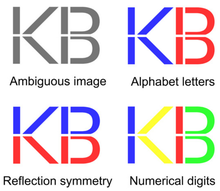
Rare example of an ambiguous epitome that can be interpreted in more than than two means: equally the messages "KB," the mathematical inequality "1 < 13" or the letters "VD" with their mirror image.[8]

"Kanizsa Triangle". These spatially dissever fragments give the impression of illusory contours (too known as modal completion) of a triangle
In ambiguous images, an illusion is often produced from illusory contours. An illusory contour is a perceived contour without the presence of a concrete gradient. In examples where a white shape appears to occlude black objects on a white background, the white shape appears to be brighter than the groundwork, and the edges of this shape produce the illusory contours.[ix] These illusory contours are processed past the brain in a like way as real contours.[7] The visual system accomplishes this by making inferences across the information that is presented in much the same way every bit the luminance gradient.
Gestalt group rules [edit]
In mid-level vision, the visual system utilizes a fix of heuristic methods, called Gestalt grouping rules, to speedily identify a basic perception of an object that helps to resolve an ambiguity.[3] This allows perception to be fast and like shooting fish in a barrel past observing patterns and familiar images rather than a slow process of identifying each part of a group. This aids in resolving ambiguous images because the visual system will have small variations in the pattern and nonetheless perceive the blueprint as a whole. The Gestalt grouping rules are the consequence of the experience of the visual system. One time a pattern is perceived often, information technology is stored in retentivity and can exist perceived again easily without the requirement of examining the unabridged object again.[half-dozen] For example, when looking at a chess board, nosotros perceive a checker design and not a set of alternating black and white squares.
Practiced continuation [edit]
The principle of good continuation provides the visual arrangement a ground for identifying continuing edges. This means that when a fix of lines is perceived, in that location is a tendency for a line to continue in one direction. This allows the visual system to identify the edges of a circuitous image by identifying points where lines cross. For case, ii lines crossed in an "10" shape volition be perceived every bit two lines travelling diagonally rather than 2 lines irresolute direction to grade "V" shapes opposite to each other. An example of an cryptic prototype would be ii curving lines intersecting at a point. This junction would be perceived the aforementioned fashion as the "X", where the intersection is seen as the lines crossing rather than turning abroad from each other. Illusions of practiced continuation are often used by magicians to trick audiences.[10]
Similarity [edit]
The rule of similarity states that images that are similar to each other can be grouped together as being the same type of object or function of the same object. Therefore, the more similar two images or objects are, the more than probable information technology will exist that they can be grouped together. For example, ii squares amidst many circles will exist grouped together. They tin vary in similarity of colour, size, orientation and other backdrop, only will ultimately exist grouped together with varying degrees of membership.[half dozen]
Proximity, common region, and connexion [edit]

The grouping property of proximity (Gestalt) is the spatial distance betwixt two objects. The closer 2 objects are, the more likely they belong to the same group. This perception tin can exist ambiguous without the person perceiving it as ambiguous. For case, two objects with varying distances and orientations from the viewer may appear to be proximal to each other, while a third object may exist closer to one of the other objects just appear farther.
Objects occupying a common region on the image appear to already exist members of the same group. This can include unique spatial location, such every bit two objects occupying a singled-out region of infinite outside of their group's own. Objects can accept close proximity merely appear equally though role of a distinct group through various visual aids such every bit a threshold of colours separating the ii objects.
Additionally, objects tin be visually connected in means such as drawing a line going from each object. These similar but hierarchical rules suggest that some Gestalt rules can override other rules.[6]
Texture segmentation and figure-footing assignments [edit]
The visual system can also aid itself in resolving ambiguities by detecting the blueprint of texture in an image. This is achieved by using many of the Gestalt principles. The texture can provide data that helps to distinguish whole objects, and the changing texture in an image reveals which singled-out objects may be part of the same grouping. Texture division rules frequently both cooperate and compete with each other, and examining the texture can yield information about the layers of the prototype, disambiguating the groundwork, foreground, and the object.[xi]
Size and surroundedness [edit]
When a region of texture completely surrounds some other region of texture, it is probable the groundwork. Additionally, the smaller regions of texture in an image are probable the effigy.[half-dozen]
Parallelism and symmetry [edit]
Parallelism is another way to disambiguate the figure of an image. The orientation of the contours of dissimilar textures in an image can decide which objects are grouped together. Generally, parallel contours suggest membership to the same object or group of objects. Similarly, symmetry of the contours tin also define the figure of an prototype.[half-dozen]
Extremal edges and relative motion [edit]
An extremal edge is a modify in texture that suggests an object is in front of or behind some other object. This tin exist due to a shading effect on the edges of one region of texture, giving the advent of depth. Some extremal border effects tin overwhelm the segmentations of surroundedness or size. The edges perceived can too assist in distinguishing objects past examining the change in texture against an border due to motion.[6]
Using ambiguous images to hide in the real world: cover-up [edit]
In nature, cover-up is used by organisms to escape predators. This is achieved through creating an ambivalence of texture partition past imitating the surrounding environs. Without existence able to perceive noticeable differences in texture and position, a predator will be unable to see their prey.[vi]
Occlusion [edit]
Many ambiguous images are produced through some apoplexy, wherein an object's texture of a sudden stops. An occlusion is the visual perception of one object being behind or in front of another object, providing information most the order of the layers of texture.[6] The illusion of occlusion is apparent in the effect of illusory contours, where occlusion is perceived despite being non-existent. Here, an ambiguous image is perceived to be an instance of occlusion. When an object is occluded, the visual organisation only has information well-nigh the parts of the object that can be seen, so the remainder of the processing must exist done deeper and must involve retentivity.
Adventitious viewpoints [edit]
An accidental viewpoint is a unmarried visual position that produces an ambiguous image. The accidental viewpoint does not provide enough information to distinguish what the object is.[12] Often, this prototype is perceived incorrectly and produces an illusion that differs from reality. For instance, an image may be split in half, with the top one-half existence enlarged and placed farther abroad from the perceiver in space. This image will exist perceived as 1 complete prototype from merely a single viewpoint in space, rather than the reality of two split halves of an object,creating an optical illusion. Street artists oftentimes utilize tricks of point-of-view to create two-dimensional scenes on the ground that appear 3-dimensional.
Recognizing an object through loftier-level vision [edit]

To go further than just perceiving the object is to recognize the object. Recognizing an object plays a crucial part in resolving ambiguous images, and relies heavily on memory and prior knowledge. To recognize an object, the visual system detects familiar components of it, and compares the perceptual representation of it with a representation of the object stored in memory.[seven] This tin be done using various templates of an object, such as "domestic dog" to represent dogs in general. The template method is not e'er successful because members of a group may significantly differ visually from each other, and may look much different if viewed from dissimilar angles. To counter the problem of viewpoint, the visual system detects familiar components of an object in three-dimensional space. If the components of an object perceived are in the same position and orientation of an object in memory, recognition is possible.[6] Research has shown that people that are more creative in their imagery are better able to resolve cryptic images. This may exist due to their power to quickly identify patterns in the paradigm.[thirteen] When making a mental representation of an ambiguous paradigm, in the aforementioned way as normal images, each part is defined and then put onto the mental representation. The more complex the scene is, the longer information technology takes to procedure and add to the representation.[14]

The Necker Cube: a wire frame cube with no depth cues.
Figures drawn in a way that avoids depth cues may become ambiguous. Archetype examples of this phenomenon are the Necker cube,[half dozen] and the rhombille tiling (viewed as an isometric drawing of cubes).
Using memory and recent experience [edit]
Our memory has a big impact on resolving an ambiguous image, as information technology helps the visual organisation to place and recognize objects without having to clarify and categorize them repeatedly. Without memory and prior cognition, an image with several groups of like objects will be difficult to perceive. Any object can have an ambiguous representation and tin exist mistakenly categorized into the incorrect groups without sufficient memory recognition of an object. This finding suggests that prior experience is necessary for proper perception.[15] Studies take been done with the utilize of Greebles to show the role of memory in object recognition.[half dozen] The deed of priming the participant with an exposure to a like visual stimulus also has a big outcome on the ease of resolving an ambiguity.[fifteen]
Disorders in perception [edit]
Prosopagnosia is a disorder that causes a person to exist unable to identify faces. The visual organization undergoes mid-level vision and identifies a face, simply loftier-level vision fails to identify who the face belongs to. In this case, the visual system identifies an ambiguous object, a face, but is unable to resolve the ambiguity using memory, leaving the affected unable to determine who they are seeing.[6]
In media [edit]
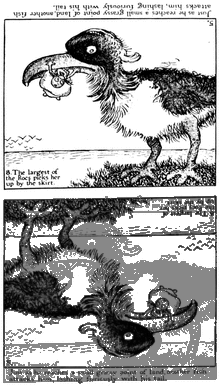
Verbeek's strips could exist seen differently when viewed upside down (this image will flip upside-down automatically)
From 1903 to 1905 Gustave Verbeek wrote his comic series "The UpsideDowns of Onetime Man Muffaroo and Little Lady Lovekins". These comics were made in such a way that ane could read the 6 console comic, flip the volume and continue reading. He made 64 such comics in total. In 2012 a remake of a selection of the comics was fabricated by Marcus Ivarsson in the book 'In Uppåner med Lilla Lisen & Gamle Muppen'. (ISBN 978-91-7089-524-i)
Employ of the ambiguous prototype phenomena can be seen in select works of M.C. Escher and Salvador Dalí. The children'due south volume, Circular Trip, by Ann Jonas used ambiguous epitome in the illustrations, where the reader could read the book front to dorsum normally at first, and then flip it upside downwards to keep the story and see the pictures in a new perspective.[16]
Gallery [edit]
-

-
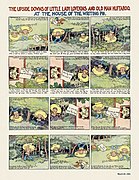
Comics The Upside Downs of Little Lady Lovekins and Former Man Muffaroo - At the house of the writing pig past Gustave Verbeek containing ambigram sentences, 1904.
-

Drawing of reversible female face by Rex Whistler, with ambigram ¡OHO!. 180° rotational symmetry. The face of a young woman changes into a grandmother. Published in 1946.
Meet as well [edit]
- Ambigram
- Binocular rivalry
- Monocular rivalry
- Multistable perception
- Negative infinite
References [edit]
- ^ Fliegende Blätter Oct. 23, 1892, p. 147
- ^ Parkkonen, L.; Andersson, J.; Hämäläinen, K.; Hari, R. (2008). "Early visual brain areas reflect the percept of an ambiguous scene". Proceedings of the National Academy of Sciences of the United States of America. 105 (51): 20500–20504. Bibcode:2008PNAS..10520500P. doi:10.1073/pnas.0810966105. PMC2602606. PMID 19074267.
- ^ a b Wimmer, M.; Doherty, One thousand. (2011). "The development of ambiguous figure perception: Vi. conception and perception of ambiguous figures". Monographs of the Club for Research in Child Development. 76 (1): 87–104. doi:10.1111/j.1540-5834.2011.00595.10.
- ^ Mast, F.Westward.; Kosslyn, S.M. (2002). "Visual mental images can be cryptic: Insights from individual differences in spatial transformation abilities". Cognition. 86 (1): 57–seventy. doi:10.1016/S0010-0277(02)00137-3. PMID 12208651. S2CID 37046301.
- ^ Chambers, D.; Reisberg, D. (1985). "Tin can mental images exist ambiguous?". Periodical of Experimental Psychology: Human Perception and Performance. 11 (3): 317–328. doi:10.1037/0096-1523.eleven.3.317. S2CID 197655523.
- ^ a b c d e f g h i j one thousand l 1000 n Wolfe, J., Kluender, Yard., & Levi, D. (2009). Awareness and perception. (2 ed.). Sunderland: Sinauer Associates.[ folio needed ]
- ^ a b c Halko, Mark Anthony (2008). Illusory profile and surface completion mechanisms in human being visual cortex (Thesis). ProQuest 621754807.
- ^ Postic, Guillaume; Ghouzam, Yassine; Chebrek, Romain; Gelly, Jean-Christophe (2017). "An ambivalence principle for assigning protein structural domains". Science Advances. three (1): e1600552. Bibcode:2017SciA....3E0552P. doi:10.1126/sciadv.1600552. ISSN 2375-2548. PMC5235333. PMID 28097215.
- ^ Bradley, D.R.; Dumais, S.T. (1975). "Ambiguous cognitive contours". Nature. 257 (5527): 582–584. Bibcode:1975Natur.257..582B. doi:x.1038/257582a0. PMID 1165783. S2CID 4295897.
- ^ Bamhart, A.Due south. (2010). "The exploitation of gestalt principles past magicians". Perception. 39 (9): 1286–1289. doi:x.1068/p6766. PMID 21125955. S2CID 8016846.
- ^ Tang, Xiangyu (2005). A model for figure-ground partitioning by self-organized cue integration (Thesis). doi:10.25549/usctheses-c16-597264. ProQuest 621577763.
- ^ Koning, A.; van Lier, R. (2006). "No symmetry advantage when object matching involves accidental viewpoints". Psychological Research. seventy (1): 52–58. doi:10.1007/s00426-004-0191-8. PMID 15480756. S2CID 35284032.
- ^ Riquelme, H (2002). "Can people creative in imagery translate ambiguous figures faster than people less creative in imagery?". The Periodical of Creative Behavior. 36 (2): 105–116. doi:ten.1002/j.2162-6057.2002.tb01059.x.
- ^ Kosslyn, S.Yard.; Reiser, B.J.; Farah, Thou.J.; Fliegel, S.L. (1983). "Generating visual images: Units and relations". Journal of Experimental Psychology: Full general. 112 (2): 278–303. doi:10.1037/0096-3445.112.2.278. PMID 6223974.
- ^ a b Daelli, 5.; van Rijsbergen, North.J.; Treves, A. (2010). "How contempo feel affects the perception of ambiguous objects". Encephalon Research. 1322: 81–91. doi:10.1016/j.brainres.2010.01.060. PMID 20122901. S2CID 45388116.
- ^ Higgins, Carter. "Round Trip – Blueprint Of The Picture Volume". Design of the Movie Volume . Retrieved ii Dec 2020.
External links [edit]
- Archimedes' Lab – Optical illusions and puzzles
- Cryptic upside-down pictures Archived 2018-ten-01 at the Wayback Machine
vasquezwhoust1944.blogspot.com
Source: https://en.wikipedia.org/wiki/Ambiguous_image
0 Response to "Hidden Images That Has a Picture in a Spiral Art"
Post a Comment